
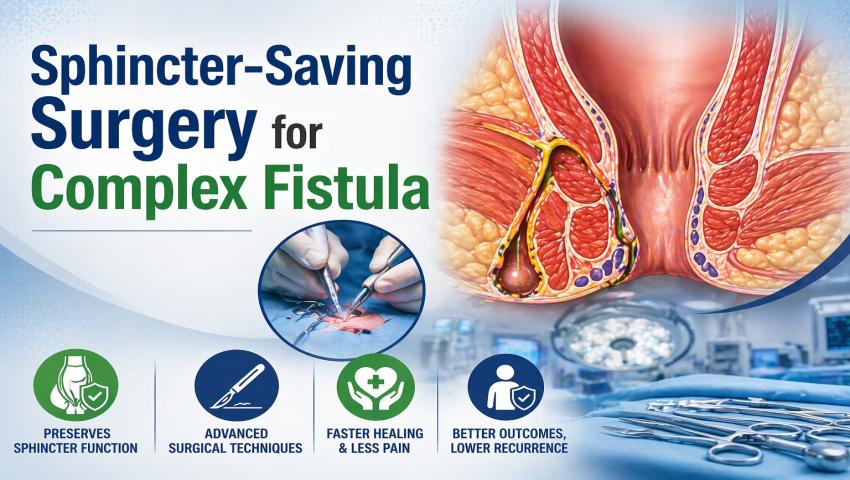
Living with an anal fistula is painful and distressing. It affects your daily life, your comfort, and your confidence. Many patients fear surgery because they worry about losing bowel control. But today, modern medicine has changed everything.
Sphincter-saving surgery is now available for complex fistula cases. It treats the fistula completely while protecting the sphincter muscles that control bowel movements.
Dr. Bhushan Chittawadagi is a leading Gastroenterologist in Bangalore. He has completed 10,000+ successful surgeries, treated 8,000+ happy patients, and maintains a 95% success rate with 18+ years of experience. He practices at HOSMAT Hospital and Trilfe Hospital, Kalyan Nagar, Bengalore.
In this complete guide, Dr. Bhushan Chittawadagi explains everything you need to know about sphincter-saving surgery for complex fistula — in simple, easy-to-understand language.
What is a Complex Anal Fistula?
An anal fistula is a small tunnel that forms between the inside of the anus and the skin around it. It usually develops after an anal abscess that does not heal properly.
A complex fistula is one that involves the sphincter muscles. It is harder to treat than a simple fistula. Standard surgery like fistulotomy may damage the sphincter in complex cases. This can lead to faecal incontinence — the inability to control bowel movements.
That is why sphincter-saving techniques are essential for complex fistula treatment.
Complex fistulas include:
- High transsphincteric fistulas
- Suprasphincteric fistulas
- Extrasphincteric fistulas
- Recurrent fistulas after previous surgery
- Fistulas associated with Crohn’s disease
- Rectovaginal fistulas
These cases need an experienced Colorectal Surgeon in Bangalore who specialises in advanced fistula surgery.
What is Sphincter-Saving Surgery?
Sphincter-saving surgery refers to a group of surgical techniques designed to treat complex fistulas without cutting or damaging the sphincter muscles.
The goal is simple — cure the fistula and protect bowel control.
These techniques are modern, evidence-based, and safe. They have transformed the treatment of complex fistulas worldwide. Patients can now get complete treatment without the fear of incontinence.
Types of Sphincter-Saving Surgeries:
Dr. Bhushan Chittawadagi offers a full range of sphincter-saving surgical options. The right technique is chosen based on the type and complexity of the fistula.
1. LIFT Procedure (Ligation of Intersphincteric Fistula Tract):
This is one of the most popular sphincter-saving techniques today.
In this procedure, the surgeon makes a small cut in the intersphincteric space — the area between the two sphincter muscles. The fistula tract is then tied and divided from within.
Benefits of LIFT:
- No cutting of sphincter muscles
- Low recurrence rate
- Minimal post-operative pain
- Short recovery time
- Safe for most complex fistulas
2. Advancement Flap Surgery:
In this technique, a flap of healthy tissue from the rectum is used to cover and seal the internal opening of the fistula. This blocks the source of infection and allows healing.
Benefits:
- Sphincter muscles remain completely intact
- Suitable for high and recurrent fistulas
- Good long-term outcomes
- Can be combined with other techniques
3. VAAFT – Video-Assisted Anal Fistula Treatment:
VAAFT is a minimally invasive, scope-guided technique. A tiny camera called a fistuloscope is inserted into the fistula tract. The surgeon can see the entire tract clearly and seal it from inside.
Benefits of VAAFT:
- No external cutting of sphincter
- Excellent visualisation of the fistula tract
- Minimal pain and faster recovery
- Very low risk of incontinence
- Can treat complex and recurrent fistulas
4. FiLaC – Laser Fistula Treatment:
FiLaC stands for Fistula-tract Laser Closure. In this technique, laser energy is used to destroy and seal the fistula tract from inside.
Benefits of FiLaC:
- Completely sphincter-preserving
- Daycare or short stay procedure
- Minimal pain and discomfort
- Quick return to normal activities
- Suitable for simple and complex fistulas
5. Seton Placement:
A seton is a surgical thread or suture passed through the fistula tract. It is used in two ways — as a cutting seton (to slowly divide the sphincter in a controlled way) or as a draining seton (to control infection before definitive surgery).
Benefits:
- Reduces infection and inflammation
- Prepares the fistula for further treatment
- Used as a bridge to sphincter-saving surgery
6. Stem Cell Therapy and Biological Glue:
In selected cases, biological agents or stem cell injections are used to close the fistula tract. These are newer techniques that are particularly useful in Crohn’s disease related fistulas.
Who Needs Sphincter-Saving Surgery?
Not every fistula needs sphincter-saving surgery. Your surgeon will evaluate your condition carefully. You may need sphincter-saving surgery if:
- Your fistula involves a large portion of the sphincter muscle
- You have had previous fistula surgery that failed
- You have Crohn’s disease with a fistula
- You are at higher risk of incontinence due to age or other conditions
- Your fistula is high, recurrent, or complex in nature
Consulting an experienced Colorectal Surgeon in Bangalore is the first and most important step.
How is the Right Technique Chosen?
Dr. Bhushan Chittawadagi follows a thorough evaluation process before recommending any surgical technique. This includes:
- Detailed clinical examination of the anal region
- MRI Fistulogram — the gold standard for mapping the fistula tract and its relation to sphincter muscles
- Endoanal Ultrasound — to assess sphincter integrity
- Proctoscopy — direct visualisation of the anal canal
- Review of previous surgical history — especially in recurrent cases
This careful diagnostic approach ensures that the most appropriate and safest technique is chosen for every patient. It also helps in preventing recurrence and protecting long-term bowel function.
Benefits of Sphincter-Saving Surgery:
Sphincter-saving surgery offers several important advantages over traditional fistula surgery:
- Preservation of bowel control — the most critical benefit
- Lower recurrence rates with modern techniques
- Minimally invasive options available — less pain, faster healing
- Shorter hospital stay and quicker return to work
- Better quality of life after surgery
- Safe for complex and recurrent cases
- Suitable for patients with Crohn’s disease
Choosing the best fistula treatment in Bangalore means choosing a surgeon who offers all these advanced options under one roof.
Recovery After Sphincter-Saving Surgery:
Recovery is generally smooth with modern techniques. Here is what to expect:
- Pain is usually mild and well-controlled with medication
- Hospital stay ranges from daycare to 2–3 days depending on the technique
- Return to work is possible within 1–2 weeks for most patients
- Dietary changes — high-fibre diet and plenty of fluids are recommended
- Wound care — keep the area clean and dry
- Follow-up visits are essential to monitor healing
Dr. Bhushan Chittawadagi provides complete post-operative guidance and support to every patient throughout the recovery process.
Complications of Untreated Complex Fistula:
Delaying treatment for a complex fistula can lead to serious problems:
- Recurring and worsening infections
- Spread of infection to surrounding tissues
- Development of sepsis — a life-threatening condition
- Enlargement of the fistula tract
- Permanent damage to sphincter muscles
- In very rare cases — risk of malignant transformation
Do not ignore a complex fistula. Seek expert care at the earliest.
Why Choose Dr. Bhushan Chittawadagi for Fistula Treatment in Bangalore?
When it comes to complex fistula surgery, the surgeon’s experience and technique make all the difference. Here is why patients across Bangalore and Karnataka trust Dr. Bhushan Chittawadagi:
- 18+ Years of Surgical Experience in Laparoscopic GI and Colorectal Surgery
- 10,000+ Surgeries Completed with a 95% Success Rate
- Sub-Specialisation in Surgical Gastroenterology from GEM Hospital, Coimbatore under the world-renowned Prof. C Palanivelu
- KS National Robotic Surgery Video Award 2021 — awarded by the Vattikutti Foundation, Detroit, USA
- Best JnJ Sponsorship Award at KSELS 2021, Seoul, South Korea
- Best Paper Award at ICES 2019 for advanced laparoscopic surgical techniques
- Full Range of Sphincter-Saving Techniques — LIFT, VAAFT, FiLaC, Advancement Flap, and more
- Advanced Diagnostic Approach — MRI Fistulogram, Endoanal Ultrasound, Proctoscopy
- Personalised Treatment Plans — every patient’s condition is unique and treated accordingly
- Two Convenient Locations — HOSMAT Hospital and Trilfe Hospital, Kalyan Nagar, Bengaluru
As the Best Gastroenterologist in Bangalore for complex colorectal conditions, Dr. Bhushan Chittawadagi combines world-class surgical skills with genuine compassion and patient-centred care.
Conclusion:
Complex anal fistula is a challenging condition. But with the right surgeon and the right technique, it can be treated safely and completely. You do not have to choose between curing your fistula and keeping your bowel control.
Sphincter-saving surgery offers the best of both. It is modern, effective, and safe.
If you are looking for the best fistula treatment, consult Dr. Bhushan Chittawadagi today. With his expertise as a trusted Colorectal Surgeon and experience as the Best Gastroenterologist in Bangalore, he will guide you to the right solution for your condition.
Do not suffer in silence. Take the first step towards a pain-free life today.